Fishing Diary for Trip Notes and Patterns
Keep free-form notes about the plan, conditions, decisions, good days, and tough days. Fishing Diary is separate from Catch Logs, so you can capture the whole trip even when there is no catch to log, while giving pattern analysis better trip context later.
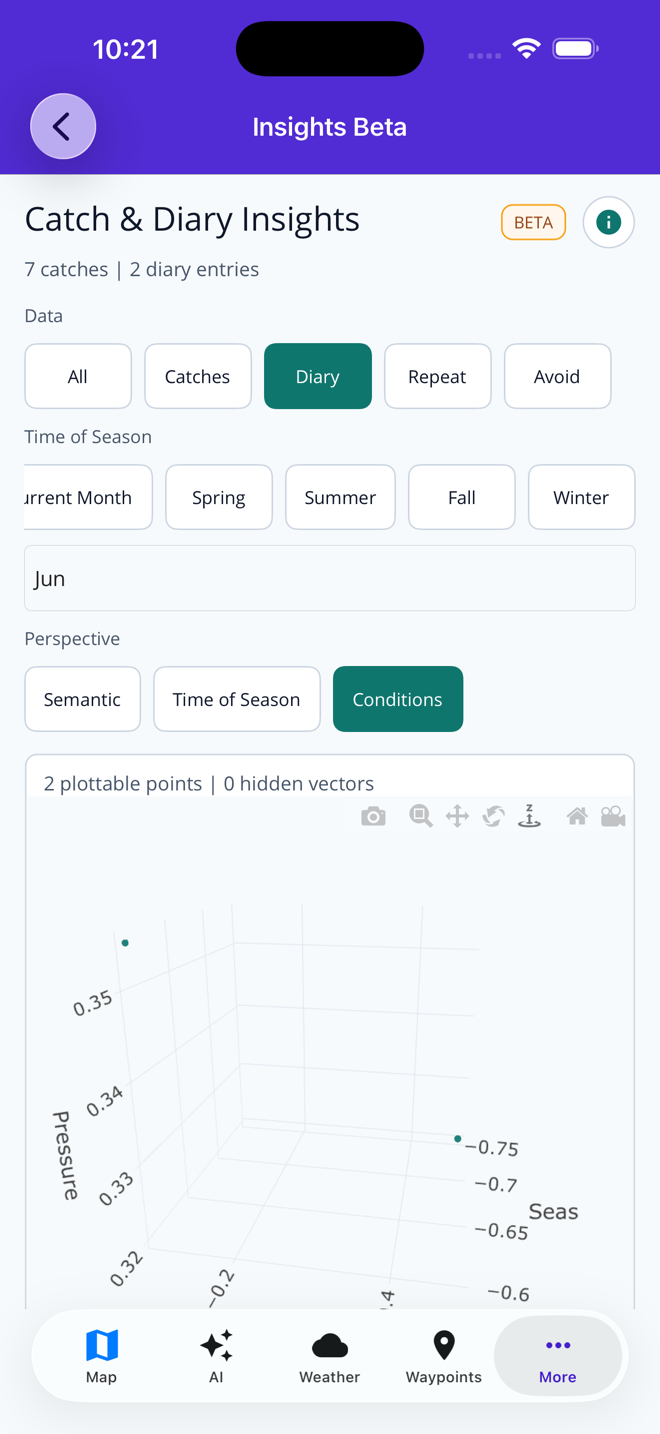
Use Fishing Diary when the story matters, not just the catch.
Catch Logs are for caught fish, photos, species, and catch-specific conditions. Fishing Diary is for private observations, trip plans, hunches, missed bites, weather notes, and lessons you want to find again later.
Free-form trip notes
Write the details that do not fit a catch record: what you tried, what changed, and what you want to remember next time.
Good days and tough days
Capture context from both productive and slow trips, including the trips where no catch log was created.
Semantic data slices
Saved embedding vectors help Fish Fathom group related diary notes and catch logs by meaning, then compare those patterns by season and conditions.
Fishing Diary gives the pattern-analysis view the trip story.
The dedicated AI Fishing Pattern Analysis page explains how Fish Fathom compares catch logs and Fishing Diary entries in a semantic 3D view. Diary notes matter because they preserve plans, observations, missed bites, and lessons that a catch-only record cannot capture.
Explore AI Fishing Pattern Analysis- Good-day and tough-day context beyond catch photos.
- Outcome labels for repeat and avoid pattern review.
- Weather, season, and trip notes for better comparisons.
Diary notes can carry the marine conditions around the trip.
When a diary entry has trip time and area context, Fish Fathom can attach a trip-time weather snapshot from the nearest station so later searches and recommendations can compare your notes against the conditions you actually saw.
Wind
Wind speed in knots for the trip window.
Sea state
Wave height and wave period for the closest available marine observation.
Temperature
Air temperature and water temperature when those readings are available.
Pressure
Barometric pressure in hPa for pressure-pattern comparisons.
Current and tide
Current speed plus tide direction to preserve movement context.
Moon and solunar
Moon phase and solunar score for timing patterns across diary entries.
Station context
Nearest station, observation time, source, and confidence score are kept with the snapshot so the context stays traceable.
Fishing Diary
- Private free-form notes
- Trip plans and observations
- Good-day and tough-day patterns
- Useful even with no catch
AI Catch Logs
- Catch-specific records
- Species, photos, and locations
- Weather context tied to catches
- Catch-history pattern review